Capacity and output answer different questions
A power bank’s nominal capacity describes its battery reserve. Its output specification describes the power it can supply under stated conditions. Neither figure on its own tells you whether it will suit a particular laptop, tablet or phone.
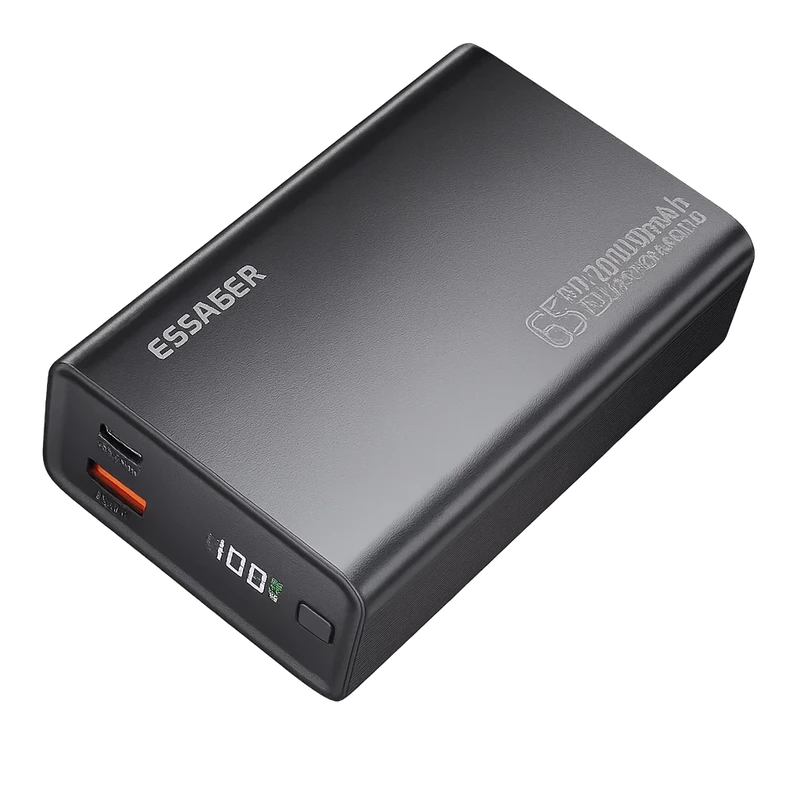
The ESSAGER F2014 listing gives 20,000mAh and 74Wh nominal capacity, with up to 65W USB-C Power Delivery output for one compatible device. These numbers belong together in the decision. A device must support an appropriate charging profile, and the cable and connection need to suit that use.
Compare your device’s requirements
Check the device manufacturer’s charging requirements rather than relying only on its connector shape. The ESSAGER source lists USB-C output profiles including 20V at up to 3.25A. Ask whether the profile your device needs is supported.
“Up to 65W” is a maximum under the listed conditions, not a statement that every connected device receives that amount. A phone can use a different supported level, and a laptop with higher requirements may not behave as you expect. Resolve compatibility before buying a travel charger around a headline wattage.
Two connected devices change the calculation
This listing states that USB-A can provide up to 18W when used alone. With two devices connected, the combined output changes to 5V at 3A, or 15W total. That is a material difference from the single USB-C maximum.
Plan your actual charging pattern. If the laptop needs the higher output, use the USB-C connection alone. If two smaller devices are the priority, assess whether the shared limit suits them. Do not add the two individual port maxima together to invent a combined rating.
Include the right cable and recharge plan
The included cable is listed as USB-A to USB-C. Full USB-C PD operation needs an appropriate USB-C to USB-C cable, and recharging at the higher listed input capability needs a suitable charger. Treat those as parts of the kit rather than assuming every supplied cable enables every mode.
Think about how the power bank itself will be recharged between uses. A portable reserve is most useful when there is a realistic opportunity to refill it. Check the wall charger, cable and storage location alongside the devices you intend to carry.
Keep runtime and travel expectations grounded
Avoid promising a fixed number of complete phone or laptop charges from nominal capacity alone. The connected device, conversion losses and use while charging all affect the practical result. The source gives battery and output specifications rather than independent endurance results.
For travel, consult the carrier’s current battery rules directly and retain the stated 74Wh figure. Check the condition of the bank and use the manufacturer’s handling guidance. A useful final checklist is simple: compatible profile, suitable cable, enough single-port output, understood shared-port limit and a plan to recharge the bank itself.
Sources & editorial note
Product facts are based on the authorized MySmartLife catalog export dated 17 October 2026 and the corresponding public listings checked 22 October 2026. Practical buying advice is our editorial interpretation. Specifications and availability should be reconfirmed before ordering.
Corrections are welcome through our contact page.